The lobby, the meeting rooms, the car park and the fitness room are yours to run, and every tenant expects them to work. We run the technology in those shared spaces, and in the marketing suite of a building that is still going up, so you have one number to call.
Tenants book a room on the building’s own booking page in a few clicks, and the screen beside the door shows how long it stays free and what comes next.
Vending, lockers, music and suppliers’ screens, online
Vending machines, parcel lockers, the music system and any screens a supplier brings, on WiFi or a cable, whichever the device needs. The supplier installs it and we make sure it is online.
A new building often passes from the developer to the owner or property manager before its fibre is in. We bring temporary 4G internet so the handover, the testing and the other contractors can go ahead, and move over to the permanent line when it arrives.
Risers, patch panels, floor boxes and the odd cable nobody can trace. We do the cabling work ourselves, so the network is not waiting on a third party.
BMS, access control, cameras, HVAC and lifts, each on its own network
The BMS, access control, cameras, HVAC, IoT sensors and lift lines all need a line out, and every supplier wants to reach their own system. Each one gets its own network, open to the people who maintain it and closed to everyone else.
Lobby, meeting rooms, terrace and the coworking floor
Lobby, meeting rooms, terrace and the coworking floor. One network across the shared spaces, guests kept apart from the building systems, and a login that does not need a conversation at reception.
A 4G line on our own SIMs stands by next to the main connection. When the main line drops, it takes over, and the payment terminals, access control and WiFi stay online.
Live output on your screens, inverters and IoT online
The inverters get a connection and the lobby screen gets the live output, so the building’s own numbers are on the wall where visitors and tenants see them.
Internet and WiFi for staff, bookings and payment terminals
The fitness room and the restaurant get internet and WiFi for their staff, their bookings and their payment terminals, each kept apart from the guests and from each other.
Guidance screens at the gate and the ramp, chargers, cameras and gates that need a connection where the phone shows one bar, and someone who is told the night they go offline.
A multi-tenant building has a layer of technology that belongs to no one. The tenants run their own networks, the landlord has a line for the cameras and the access control, and the shared spaces get whatever was left over. That is the layer we take on and run as one network: an internet line with a backup, WiFi in every shared space, VLANs that keep the building systems away from the guests, and screens in the lobby that show what people need to know.
You get a team that already knows the building, a report every month and one fixed monthly amount that can run through the service charges. What a single tenant uses on its own can be billed to that tenant directly. Your tenants get WiFi that works in the restaurant and the fitness room, and a lobby screen that tells them when the next train leaves.
“Their solutions have exceeded our expectations, significantly improving our network reliability and performance.”
Translated from English
What we take care of in a building
Internet for the building systems
The BMS, access control, cameras, HVAC, IoT sensors and lift lines all need a line out, and every supplier wants to reach their own system. Each one gets its own network, open to the people who maintain it and closed to everyone else.
Lobby, meeting rooms, terrace and the coworking floor. One network across the shared spaces, guests kept apart from the building systems, and a login that does not need a conversation at reception.
Tenant services, plugged in
Vending machines, parcel lockers, the music system and any screens a supplier brings, on WiFi or a cable, whichever the device needs. The supplier installs it and we make sure it is online.
Fitness, restaurant and payments
The fitness room and the restaurant get internet and WiFi for their staff, their bookings and their payment terminals, each kept apart from the guests and from each other.
A backup line that takes over
A 4G line on our own SIMs stands by next to the main connection. When the main line drops, it takes over, and the payment terminals, access control and WiFi stay online.
Internet from the day of handover
A new building often passes from the developer to the owner or property manager before its fibre is in. We bring temporary 4G internet so the handover, the testing and the other contractors can go ahead, and move over to the permanent line when it arrives.
A piece of the finished building, before it is finished.
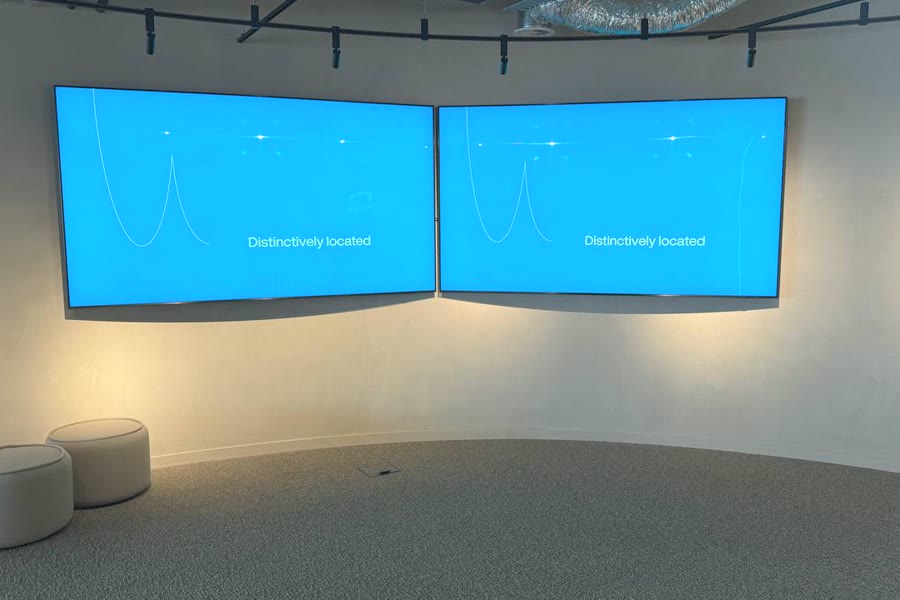
A marketing suite has to sell a building that is not finished yet. We fit it out as if the building were already open: a synchronised video wall that plays your film across as many screens as the wall can take, without a video wall controller to buy, WiFi and internet that behave the way they will on day one, and real desks with a real connection where the sales team works and a visitor can sit down and try the place.
A suite lasts a few months to a few years, so we install it as something that leaves: when the building opens or the next project starts, the wall, the desks and the network come down and go up again at the next address. The wall at Covent Garden in Brussels is one of ours. Ask us to show you.
At Blue Tower on Avenue Louise, BNP Paribas Real Estate asked for one connection in place of several separate lines. The building now has one line with a 4G backup, WiFi across the shared spaces and a lower monthly bill. At Pegasus Park in Diegem the WiFi has to work indoors, outdoors and in the underground car park where phones give up, with one point of contact for the property manager.